
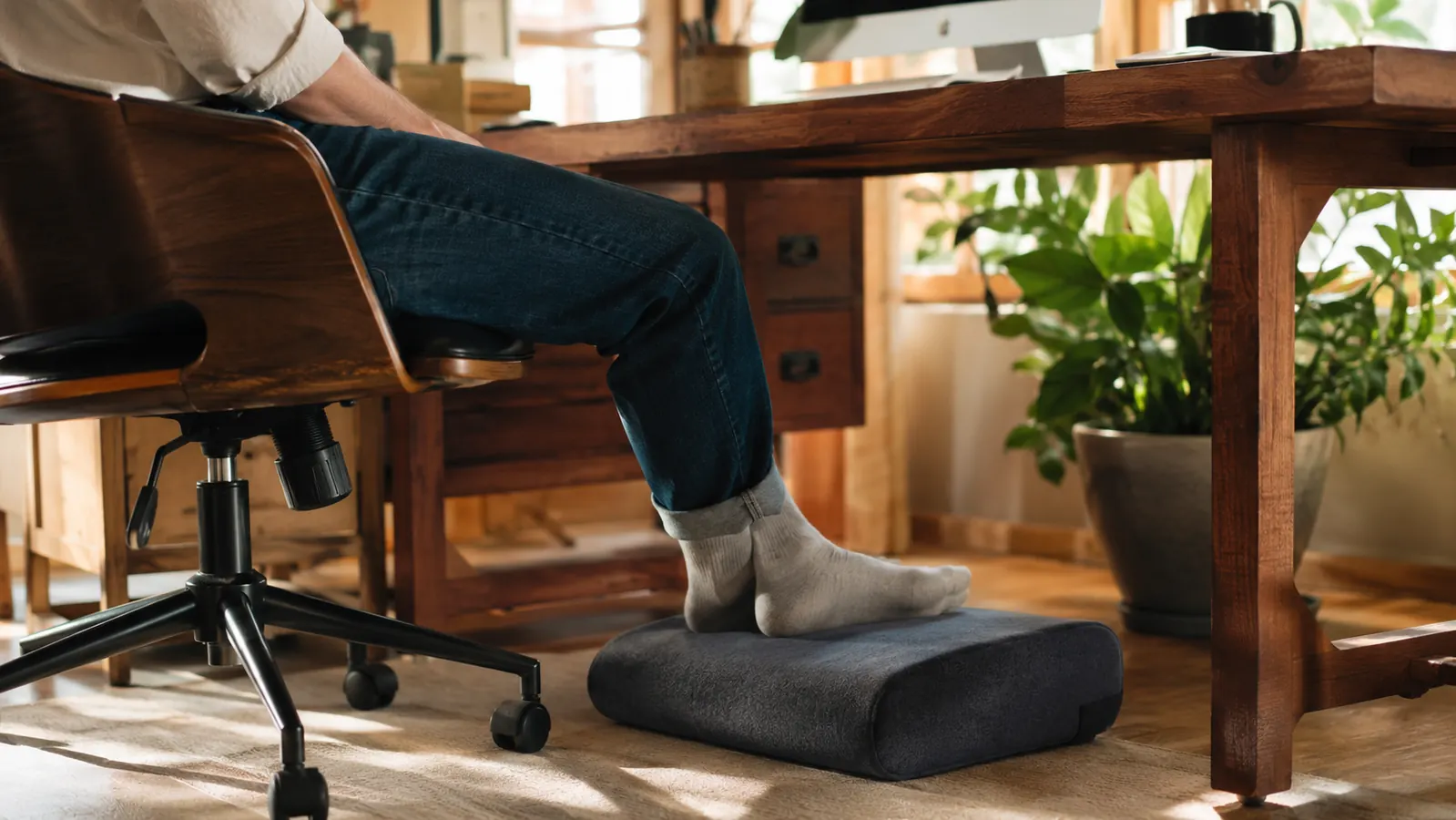
I bought the Everlasting Comfort footrest in November 2024. My desk chair sits a few centimeters too high for my inseam, and after a full year of working from home I had developed a persistent ache behind both knees by late afternoon. My physical therapist suggested elevating my feet a few inches to reduce the pressure at the back of my thighs. I looked at a handful of options, saw this one had over 25,000 reviews and cost well within budget, and ordered it without much analysis. That was 18 months ago. I have used it every single workday since.
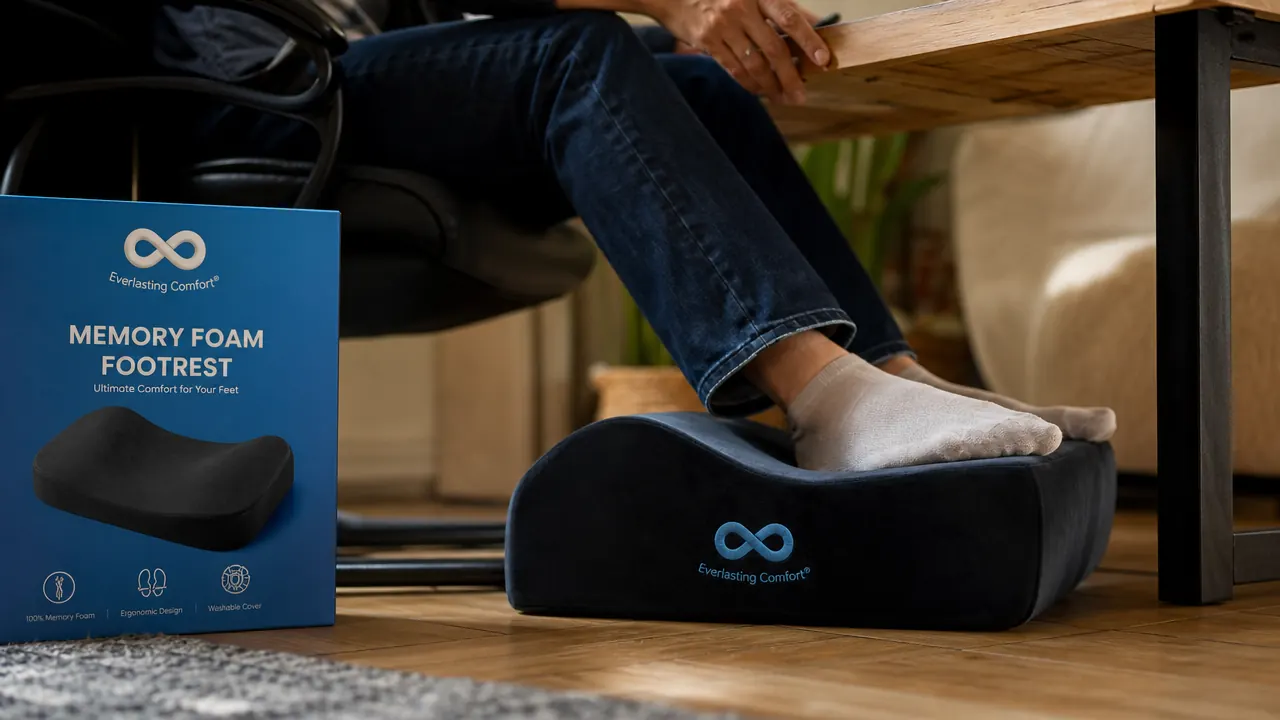
This is the long-term review. I am not going to tell you about unboxing or how soft it felt on day one. I am going to tell you whether the foam still does anything useful after a year and a half of daily contact, whether the velvet cover holds up to real use, and who should actually bother buying one of these versus looking at something different.
The Quick Verdict
A genuinely useful ergonomic fix for short-to-average height desk workers; the foam compresses over time but stays functional, and the price makes it an easy buy even if you replace it after two years.
Amazon Check Today's Price →If your legs ache or go numb before your workday ends, this is the budget fix worth trying first.
The Everlasting Comfort footrest has 4.6 stars across 28,000+ reviews. Check current availability and pricing on Amazon before reading further.
Amazon Check Today's Price on Amazon →How I Have Used It
My home office setup is a 60-inch solid wood desk at fixed height with a mesh task chair. I am 5 feet 9 inches tall and my chair's lowest position leaves my feet slightly short of flat on the floor when my keyboard is at a comfortable height. That gap is small, maybe two to three inches, but it is enough to put sustained pressure on the underside of my thighs over a long workday. The footrest sits directly in front of my chair, centered under the desk, and my feet rest on it throughout the day.
I do not wear shoes in my home office. I work in socks or barefoot, which matters because the velvet cover behaves differently under bare skin versus leather-soled shoes. More on that in the surface wear section. My typical workday runs eight to ten hours with roughly two hours of standing breaks scattered throughout. So the footrest sees six to eight hours of contact per day, five days a week, for 18 months. That is somewhere around 1,200 to 1,400 hours of cumulative use.
I have not washed the cover. I have spot-cleaned it twice with a damp cloth. I have slid it forward and back under the desk probably hundreds of times as I shift position in my chair. I am telling you all of this because I want you to understand the conditions I am evaluating it under. This is not a lab test. It is a desk.
Foam Compression: The Question Everyone Should Be Asking
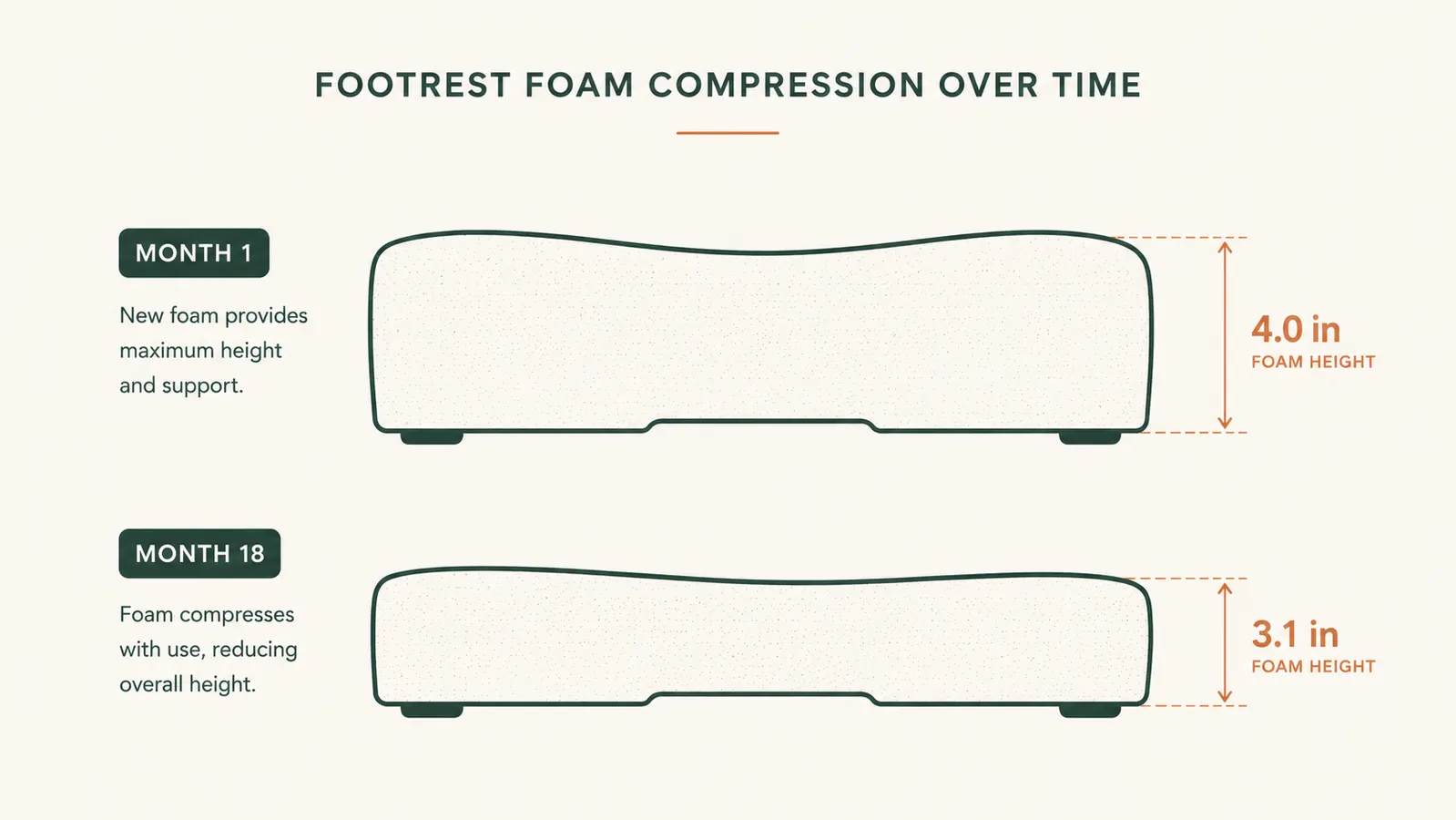
The single most important question about a memory foam footrest is whether the foam compresses over time to the point of becoming useless. I measured the height of the footrest at month one and again at month eighteen using a flat ruler pressed along the side. At month one, the resting height at the center of the footrest was approximately 4.5 inches. At month eighteen, that same measurement is approximately 3.8 inches. That is roughly 15 percent compression from the peak.
The practical effect is noticeable but not crippling. The footrest still elevates my feet. It still distributes pressure away from the back of my thighs. But the soft, giving quality it had in the first few months has flattened out. It now feels more like a dense cushion than a memory foam product. If you are buying this primarily for the plush, responsive memory foam feel, understand that you are buying a one-to-two year product, not a five-year product.
Where it holds up well is firmness consistency. The compression appears to have plateaued around the twelve-month mark. Months twelve through eighteen have shown very little additional change. The foam did not collapse; it settled. There is a real difference between those two outcomes.
The foam compressed about 15 percent over 18 months, then plateaued. It stopped feeling like memory foam and started feeling like a firm cushion. That is still useful. It is just different from what the listing implies.
Surface Wear and the Velvet Cover
The dark charcoal velvet cover shows lint. If your home office has light-colored carpet or furniture, expect the cover to attract fibers. I vacuum mine with an upholstery attachment once a week and that keeps it clean enough. The velvet itself has not pilled badly, which surprised me. I expected the repeated sock friction to roughen the surface significantly. After 18 months it is slightly less plush-feeling than new but the texture is intact.
The non-slip bottom grips the hardwood floor of my office without issue. I have never had it shift unexpectedly under my feet, even during a restless afternoon of fidgeting. On carpet, reviewers report slightly more drift over a full day. My floor is hardwood so I cannot speak to that from personal experience, but the rubberized base looks adequate for low-pile carpet.
One genuine issue: the cover is not removable for machine washing. You can spot-clean it but you cannot strip it off and run it through a laundry cycle. After 18 months mine has a faint odor that spot-cleaning does not fully address. It is not strong, and it does not bother me enough to replace the product, but it is worth knowing if you are sensitive to that kind of thing.
Ergonomic Effect Over Time
The behind-the-knee ache that prompted me to buy this is gone. I cannot attribute that entirely to the footrest because I also adjusted my monitor height and stopped crossing my legs around the same time. But the footrest is the change I made first, and the improvement was noticeable within two weeks. My best guess is that it accounts for roughly half the improvement, with better chair height and posture habits accounting for the rest.
At month eighteen, with the foam compressed to its settled state, I still feel the ergonomic benefit. The angle my footrest creates is slightly shallower than it was at month one because the foam is shorter, but it still tilts my feet forward enough to reduce thigh pressure. Whether that benefit will persist another 18 months without replacing the footrest is genuinely uncertain. My guess is another year of usefulness before the compression becomes problematic.
For reference, I am 5 feet 9 inches and this product works well for me. If you are over 6 feet tall with a longer inseam, the elevation this provides might not be enough. You would want to look at a taller footrest or an adjustable-height platform instead.
What I Liked
- Immediately reduces pressure at the back of the thighs for desk workers whose chair sits too high
- Foam compression has largely plateaued after 12 months, so it does not keep degrading indefinitely
- Non-slip base works well on hardwood, does not drift during normal workday movement
- Very affordable, making replacement every two years a low-cost maintenance decision
- Sits at a good height for workers between 5 feet 5 inches and 5 feet 11 inches
Where It Falls Short
- Cover is not removable or machine-washable, which limits deep cleaning options
- Velvet attracts lint and requires regular vacuuming to stay presentable
- Memory foam feel diminishes significantly after 12 months as the foam settles
- Taller users may find the elevation insufficient for meaningful ergonomic benefit
How It Compares to Adjustable Footrests
I have used one adjustable-height footrest before this one, a plastic platform with a ratchet height mechanism. The adjustability sounds appealing on paper: dial in the exact angle and elevation for your body. In practice, I found myself leaving it at one setting and never touching the adjustment. The plastic surface was uncomfortable on my bare feet, and after a week I stopped using it. The Everlasting Comfort wins for me because the surface is more pleasant for all-day barefoot contact.
That said, adjustable footrests make more sense in shared office environments where multiple people use the same workstation, or if you expect your seating arrangement to change frequently. For a dedicated home office with a fixed chair setup, the memory foam footrest is the simpler and more comfortable choice. The full comparison lives at the memory foam vs adjustable footrest article if you want more detail on the trade-offs.
Who This Is For
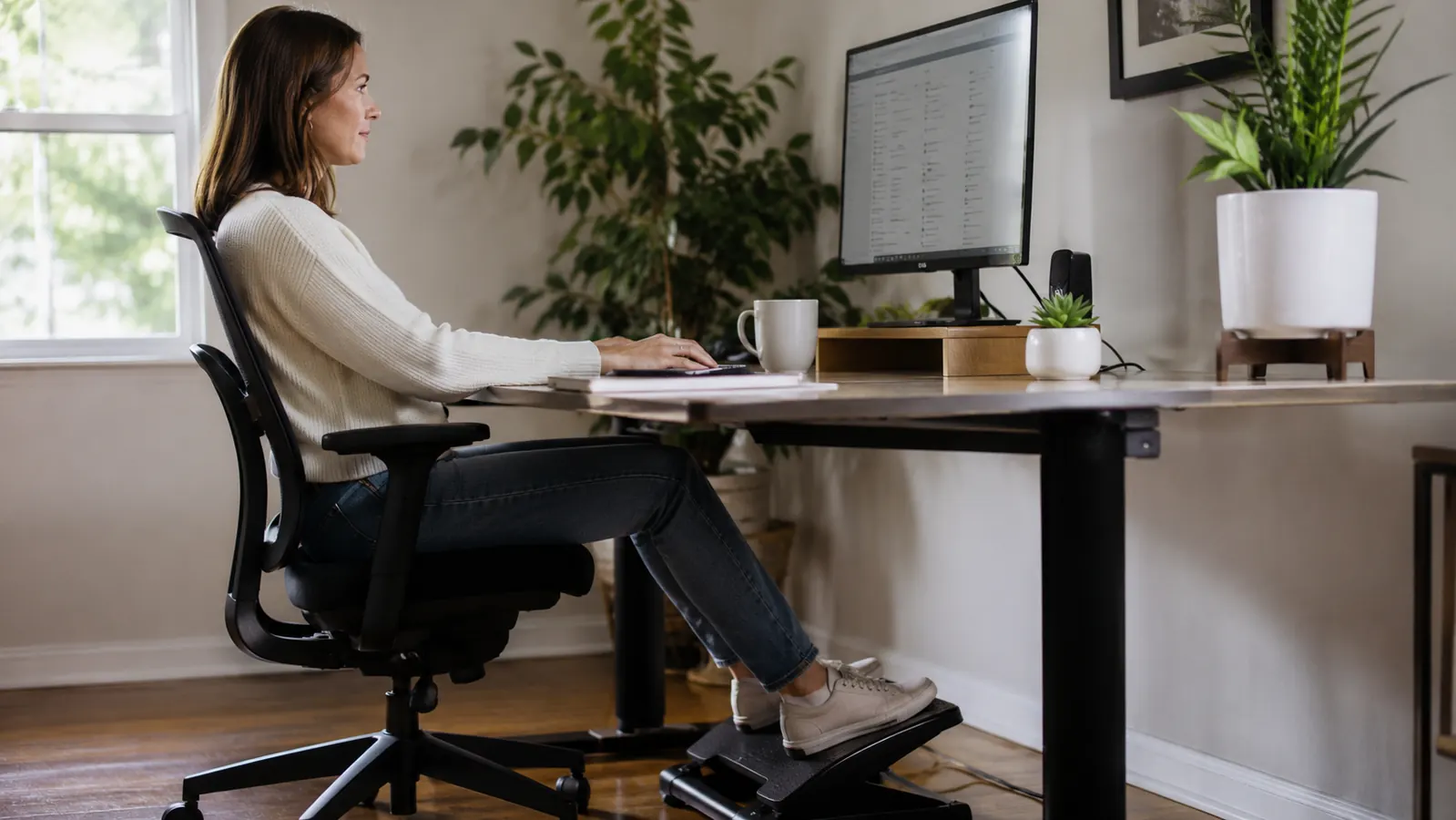
This footrest is a good fit if your chair's lowest position still leaves your feet short of flat on the floor, if you experience behind-the-knee fatigue or thigh pressure after extended sitting, or if you work at a fixed-height desk you cannot adjust. It is also worth considering if you sit for more than six hours a day and have not addressed foot and leg positioning at all. For most people in that situation, a footrest is the cheapest ergonomic win available before you get into chair upgrades or standing desk converters.
The Everlasting Comfort specifically is the right choice if you prefer a soft surface for bare feet or socked feet, you want to spend in the budget range without doing much research, and you are comfortable replacing it every two years as the foam settles. It is a consumable ergonomic accessory, not a permanent piece of equipment. Budget for it accordingly.
Who Should Skip It
Skip this footrest if you are over 6 feet tall with a proportionally longer inseam. The elevation it provides at its peak height is modest, and as the foam compresses it becomes even shallower. You will need a taller solution. Also skip it if you share a workstation with someone of a meaningfully different height, or if the ability to wash the cover is important to you. The non-removable cover is a genuine limitation for people who prioritize cleanliness. And if you are dealing with diagnosed plantar fasciitis or a specific clinical posture issue, an occupational therapist should guide your footrest selection rather than an Amazon listing.
If you are curious about adding a footrest as part of a broader ergonomic setup improvement, the 10 reasons a footrest belongs in every home office article walks through the specific ergonomic logic behind foot positioning at a desk. Worth reading if you are still on the fence about whether a footrest addresses your actual problem.
Your legs should not ache by 3pm. An affordable footrest is the first thing to try.
The Everlasting Comfort footrest has held up well enough over 18 months that I would buy it again at this price. Check current pricing and stock on Amazon.
Amazon Check Today's Price on Amazon →