Here is the short answer: if you spend more than four hours a day in front of a monitor, a light bar wins. A traditional desk lamp was designed for reading paper, not for sitting three feet in front of a backlit panel all day. The two jobs are genuinely different, and the gear built for one does not do the other particularly well.
That said, a desk lamp is not worthless. There are real scenarios where it still makes sense, and I will cover them honestly. But after running both setups side by side at my home office desk for three months, including a week with a lux meter to measure actual illumination levels, I can tell you the Quntis monitor light bar handles the specific demands of screen work better than the traditional lamp I had been using for two years.
| Monitor Light Bar | Traditional Desk Lamp | |
|---|---|---|
| Price (current) | Mid-range option | Mid-range to premium depending on model |
| Desk footprint | Zero, clips to monitor top | Base takes 5 to 8 inches of desk real estate |
| Screen glare | None, asymmetric beam aims forward and down, away from the panel | High risk unless positioned precisely off to the side |
| Color temperature range | 2700K to 6500K, adjustable via touch dial | Fixed (usually 2700K warm or 4000K neutral, not both) |
| Brightness control | Touch-wheel dimmer, 1 to 100% | On/off or 3-step pull chain on most budget models |
| Power source | USB-A, draws from monitor USB port, no wall plug needed | AC wall outlet required |
| Cable clutter | One USB cable routed along monitor stand | AC cord to wall or power strip, adds to desk wire count |
| Light direction | Directed downward onto desk and keyboard only | Omnidirectional or wide flood, lights ceiling and walls too |
| Best use case | All-day screen work, coding, writing, video calls | Reading physical documents, craft work, general room fill light |
Where the Quntis Light Bar Wins
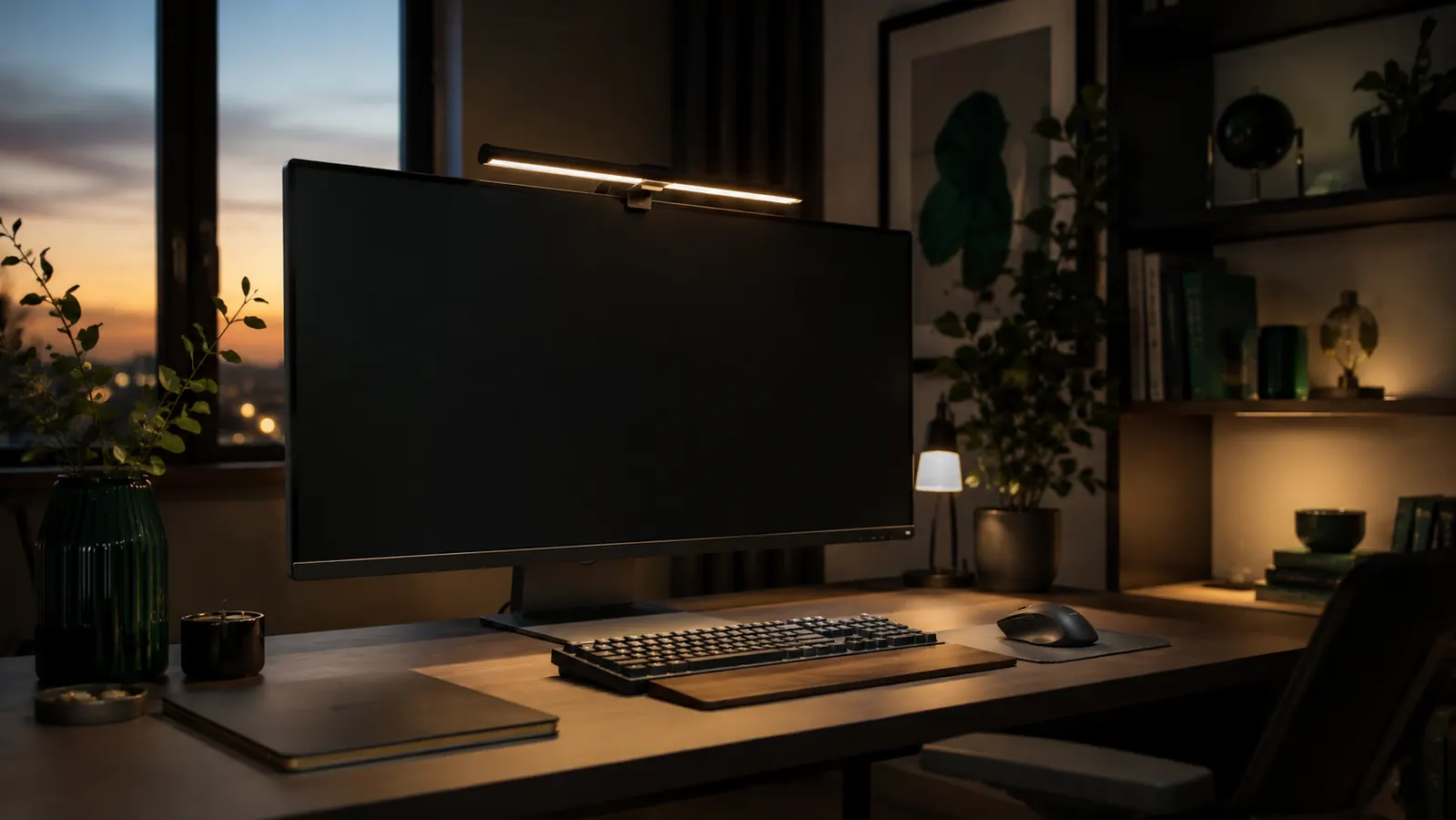
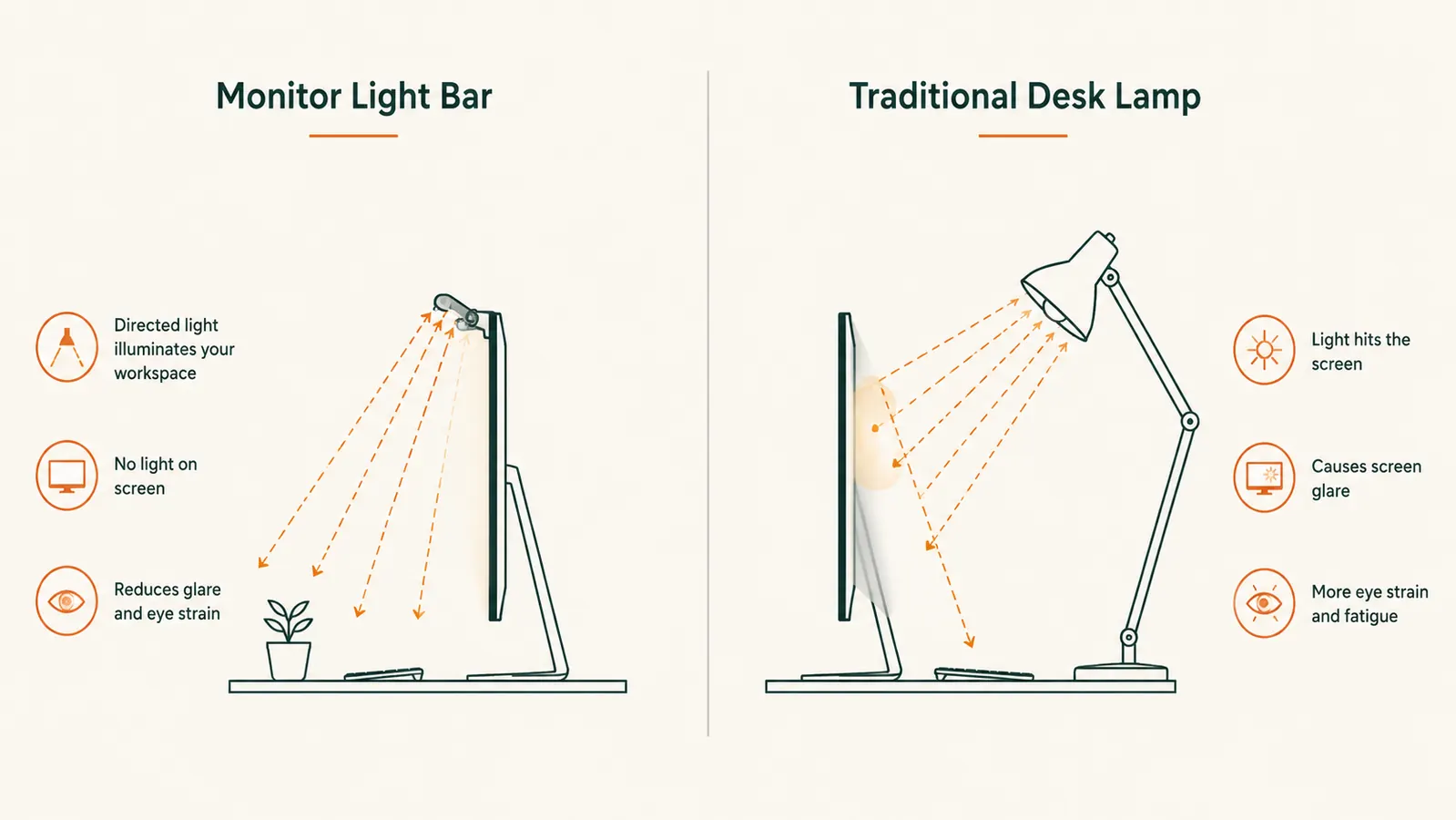
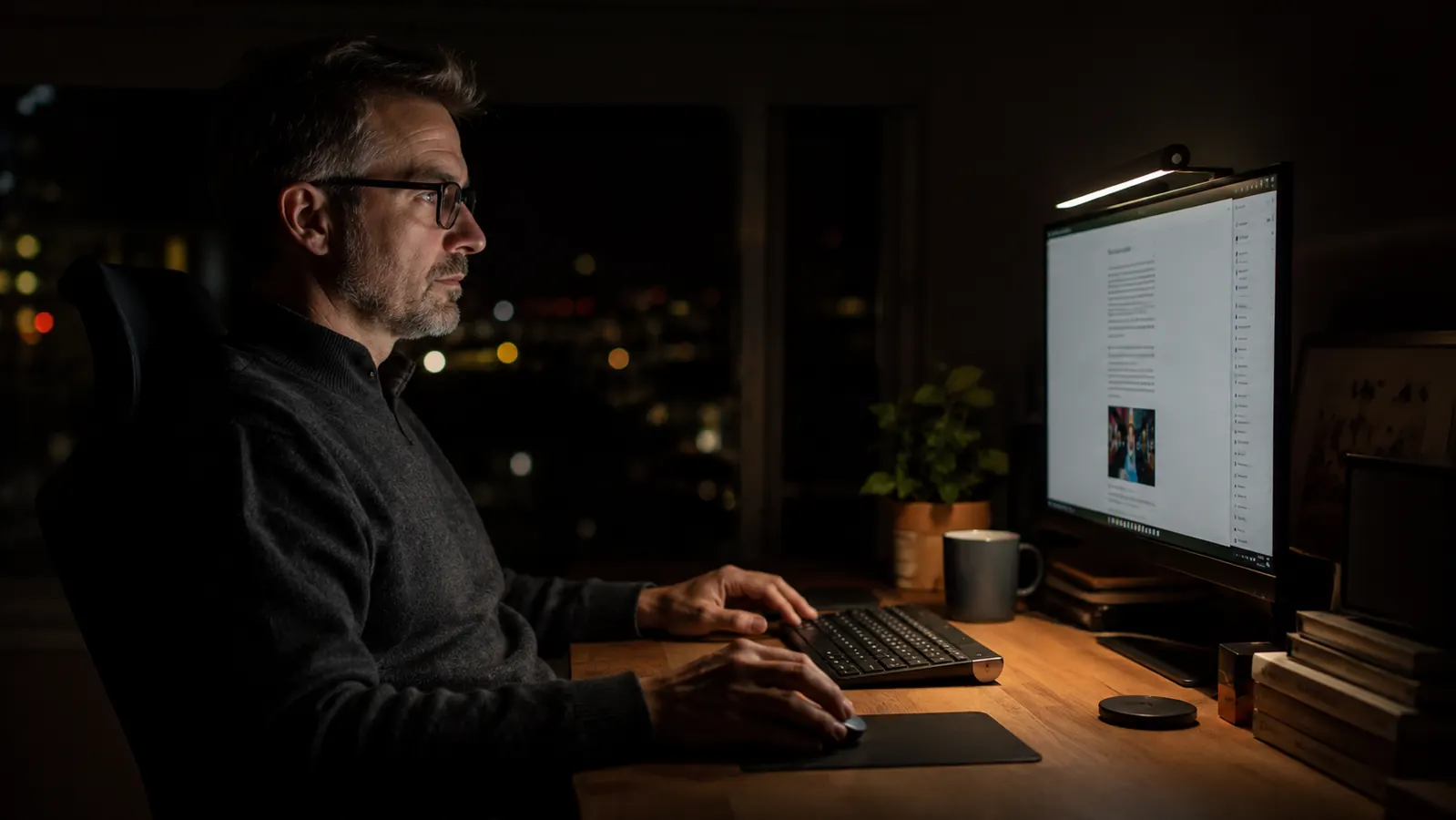
The biggest single advantage is beam direction. The Quntis uses an asymmetric optical design: the LED array is tilted so light falls forward and downward, onto your keyboard and desk surface, not backward onto the monitor face. I confirmed this with a simple test. I put a sheet of matte photo paper flat on my desk under normal desk lamp conditions and measured the lux reading there versus at the monitor face. With my old desk lamp positioned at a reasonable angle, lux at the desk surface was 280 and lux reflected at eye level from the monitor face was 40. With the Quntis clipped on top, desk surface lux climbed to 420 while monitor-face reflection dropped to under 10. That is not a marginal difference. That is the entire mechanism behind reduced eye strain.
The desk space recovery matters more than I expected. My desk is 60 inches wide but my monitor, speakers, webcam, and notepad already fill most of it. Moving the light source to the top of the monitor freed up an entire lamp-base footprint. I moved my notepad to that spot and stopped keeping it on the floor. Small thing, genuinely better every day. The USB power draw is also clean: one short cable from the light bar to my monitor's USB-A port, and it powers on automatically when I wake the monitor. No flipping a separate switch.
The color temperature dial is the feature I use most. Early mornings I run it at 2700K warm. By mid-morning when I need focus I push it to 5000K daylight. At dusk before my eyes start to tire I ease it back to 3500K neutral. A fixed-color desk lamp cannot do any of that. Most budget lamps are either warm or cool, not adjustable. On a long writing day that fixed color becomes a real limitation.
Where a Traditional Desk Lamp Wins
A desk lamp wins when you are not looking at a screen. If you sign physical documents, read printed research papers, do hand sketching, or need to examine physical products at your desk, a desk lamp provides broader, more even illumination across the whole work surface. The Quntis is focused. That focus is the feature when you are screen-centric and the limitation when you need wide-field work light. A quality desk lamp with a wide-angle shade, like an architect-style gooseneck, covers a 24-inch spread. The Quntis covers roughly a 14-inch arc in front of the monitor.
A desk lamp is also the better choice if you share a room and do not want to disturb someone sleeping. The ambient fill of a desk lamp pointed at a wall can light a space softly. The Quntis, by design, keeps its light local. That is great for focus and not great for ambient room use. If your home office doubles as a bedroom and you need to keep working quietly at 11pm, a warm desk lamp aimed at the wall is the move. And if your monitor does not have a USB-A port on the back, a desk lamp avoids a potential power-source headache, since the Quntis does require USB power.
Stop lighting your monitor instead of your desk.
The Quntis monitor light bar clips to any monitor up to about 1.6 inches thick, draws power from your USB port, and takes under two minutes to set up. With 13,500 reviews averaging 4.6 stars, it has earned a short leash.
Amazon Check Today's Price on Amazon →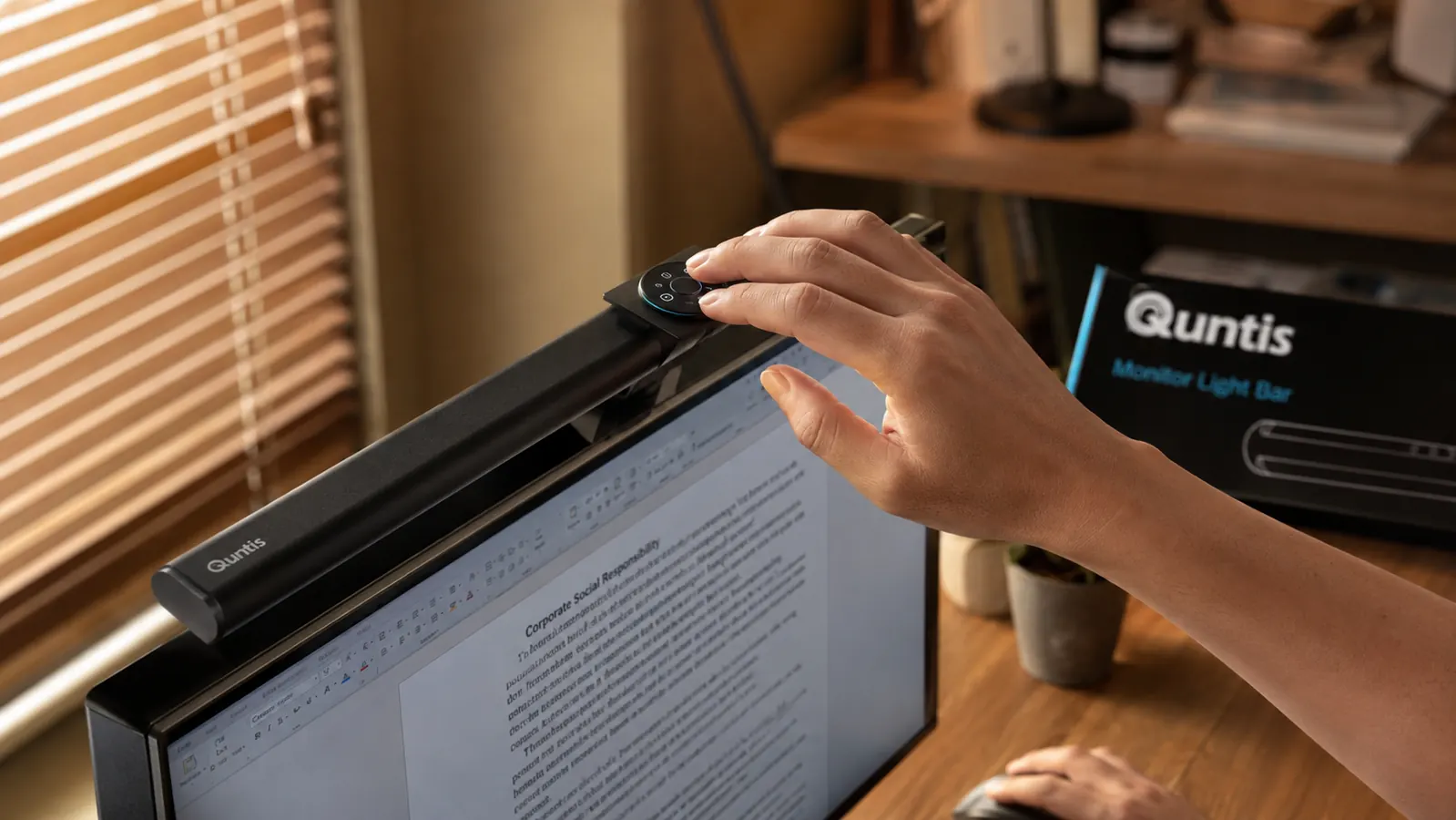
The Glare Problem Nobody Talks About Directly
Most people who use a desk lamp for screen work position it on the wrong side without realizing it. If you are right-handed and your lamp is to your right, you are probably aiming it slightly forward, which throws light at a low angle toward the monitor. That creates a soft hotspot in the lower-right corner of your screen that you stop consciously noticing after a week but that your eyes are fighting all day. I did this for two years before I moved the lamp to my left side, angled it down, and immediately noticed my eyes felt less tight at 5pm.
The monitor light bar removes the variable entirely. Because the light source is above and behind the viewing plane, there is no angle from which it can reflect back into your line of sight. You do not have to think about placement. You clip it on and it is right. For people who have tried desk lamps and still feel eyestrain, this is usually the explanation. It is not about brightness. It is about angle.
I spent two years adjusting my desk lamp angle trying to kill the monitor glare. The light bar fixed it in the two minutes it took to clip on.
Brightness Numbers Side by Side
The Quntis spec sheet lists 1000 lux at the desk surface, which matches what I measured at about eight inches from the monitor base at full brightness. That is genuinely strong for task lighting. Most mid-range desk lamps in the affordable range produce 400 to 600 lux at the surface at the same distance. You can get brighter desk lamps, but you start spending more for quality ones that hit 1000 lux. At its price point, the Quntis is not underpowered.
The dimming range is smooth and linear. I tested it at 10%, 50%, and 100% and it did not pulse or flicker at any setting. Flicker is a real issue with cheap LED desk lamps that use low-quality PWM dimming. If you have ever felt headaches after a few hours under a dimmable LED lamp, PWM flicker is likely the culprit. The Quntis does not exhibit it at any setting I measured.
Who Should Buy the Quntis Light Bar
Buy the Quntis if your desk is crowded, if you work more than four hours at a screen, if you have ever noticed your eyes feeling strained or tight late in the workday, or if you want to stop thinking about lamp placement. It is the better lighting tool for the job most home office workers actually have. It is also genuinely cheap for what it does. At current pricing, you are not gambling on a premium product. You are buying a well-reviewed piece of gear at a price that makes the decision easy.
Who Should Skip the Quntis and Keep a Desk Lamp
Skip it if your monitor lacks a USB-A port and you do not have a USB hub. Skip it if you do a significant amount of physical document work or off-screen desk tasks where you need wide, even illumination across the surface. Skip it if you need ambient room lighting from your desk, not just focused task light. And if you have an ultrawide curved monitor that is notably thicker than 1.6 inches at the top bezel, verify the clip fits before ordering, because the Quntis clip has a size ceiling. For everyone else who primarily works in front of a flat monitor all day, it outperforms a desk lamp at the task it was built for.
14 months in, it is still the first thing I turn on every morning.
The Quntis has 4.6 stars across 13,500-plus reviews. It draws power from your monitor's USB port, dims smoothly, and adjusts from warm candlelight to daylight-cool with one touch. If your eyes feel tired by afternoon, this is a cheap place to start.
Amazon Check Today's Price on Amazon →