
Here is the thing about the KANGAROO anti-fatigue mat that nobody writes plainly: it is a kitchen mat. The original product description says it right in the title, 'Anti Fatigue Mats for Kitchen Floor.' It was not designed for a standing desk workspace. It has been adopted by standing desk users because it works reasonably well, costs less than mid-range options, and ships fast. That context matters when you are evaluating it, because understanding what it is actually built for helps you calibrate your expectations correctly.
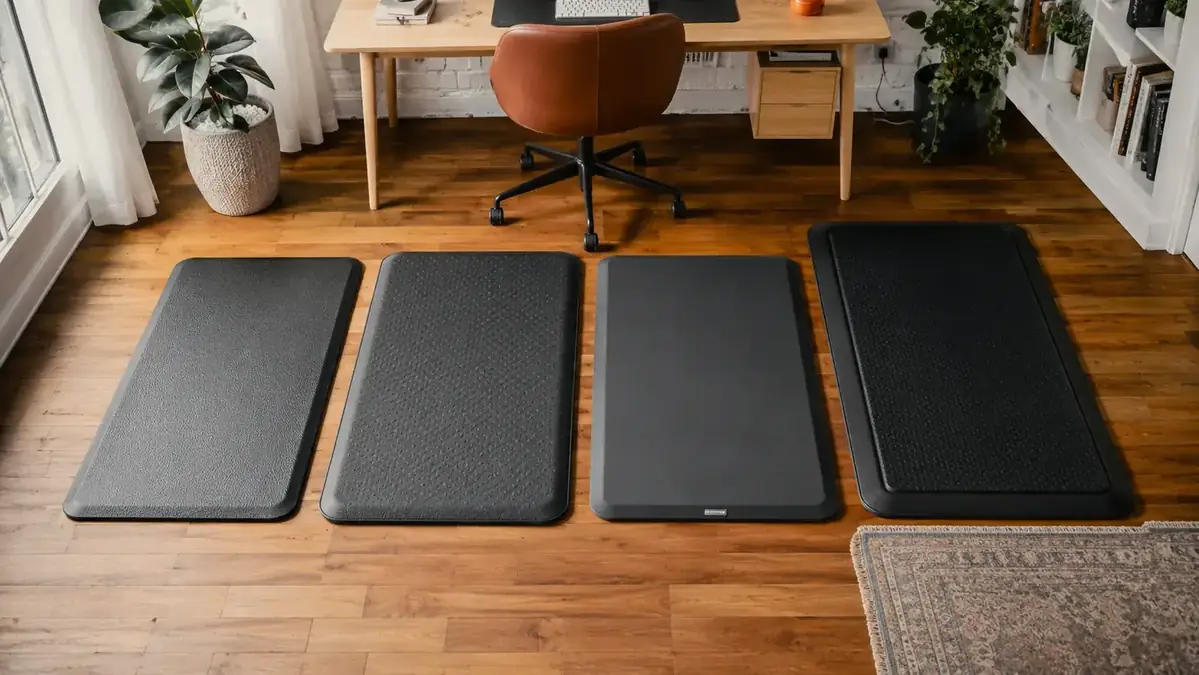
I have stood on four mats at my home office desk over the past couple of years. The KANGAROO, a Sky Solutions cushion mat, an Ergodriven Topo, and a no-name generic I bought first and regretted immediately. I am writing this review for the person who is standing on a hard floor right now, whose feet hurt by 1 p.m., and who wants a straight answer on whether the KANGAROO is worth it or whether the marketing on the Amazon listing is more polished than the actual product.
The Quick Verdict
The KANGAROO earns its keep for most standing desk users at its price point, but the listing oversells the foam quality and undersells the limitations. Know what you are buying before you click.
Amazon Check Today's Price →Your feet hurt by midday because hard floors were not designed for standing eight hours. One mat fixes that fast.
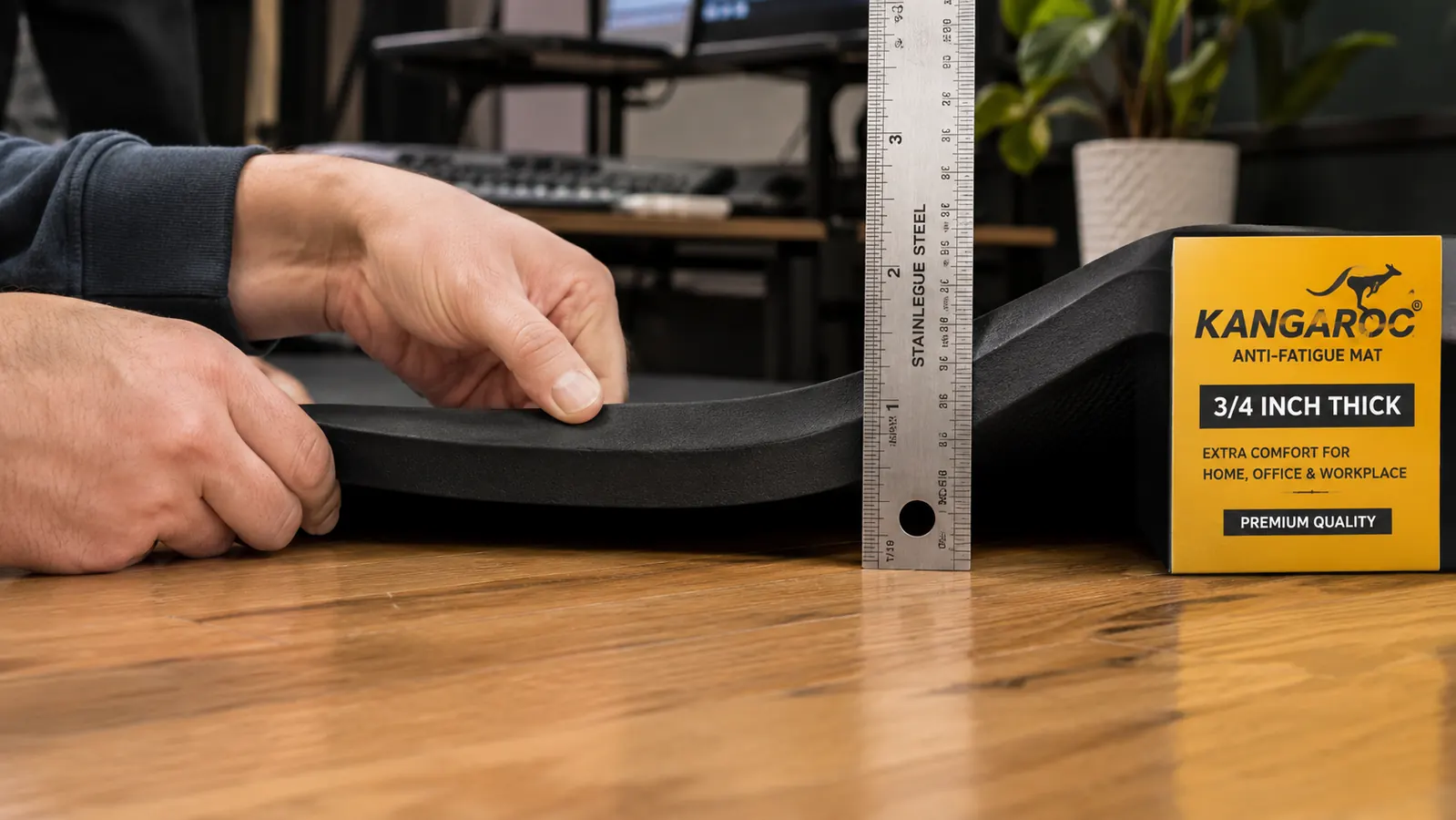
The KANGAROO anti-fatigue mat is 3/4 inch thick PVC foam with beveled edges on all four sides. It runs at a budget-friendly price most days and it handles the basics well for most home office standing setups. If you are standing on hardwood or tile right now, this is the most practical upgrade you can make this week.
Amazon Check Today's Price on Amazon →What the Amazon Listing Gets Right and Where It Stretches the Truth
The listing claims the KANGAROO provides 'premium' comfort and is built for extended standing. The 'premium' language is marketing noise. The foam is standard PVC, the same category of material used in every budget mat in this price range. What makes it decent is not the material, it is the density and the edge construction. The foam is firmer than most budget mats, which matters for how long it lasts before it compresses flat. The edge bevel is actually well done. Those two things are real.
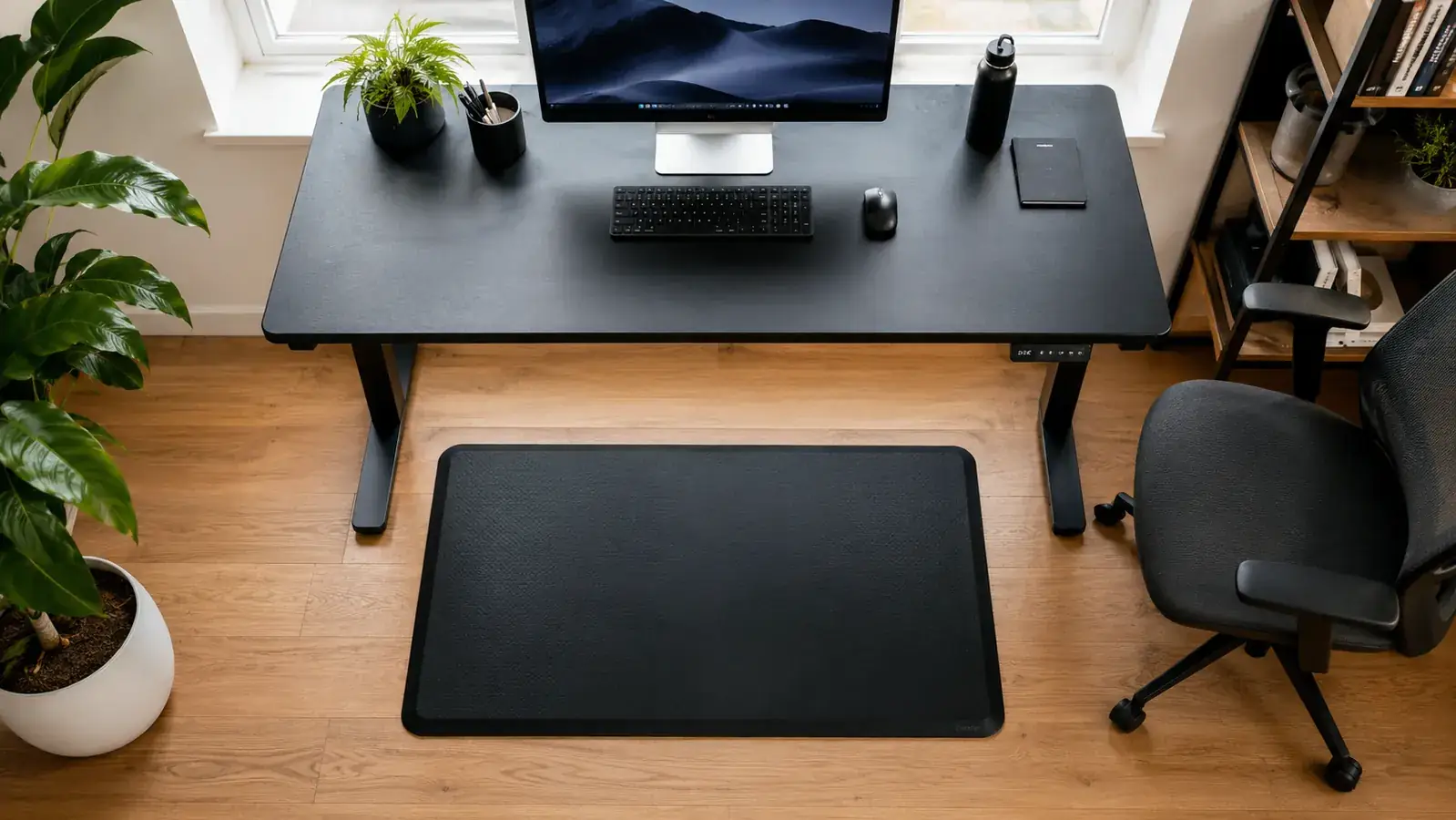
Where the listing misleads you: the size. KANGAROO lists multiple sizes on the same product page, and the images show a mat that looks generous in footprint. When you receive the 20-by-32-inch version, which is the most commonly purchased size, it is smaller than most people picture from the listing photos. The product page does show the dimensions clearly if you read the specs. Most buyers do not read the specs. They look at the hero image, which is shot from a low angle that makes the mat look larger relative to the person standing on it. I was one of those buyers the first time.
The review count is also worth scrutinizing. Over 17,000 reviews sounds like overwhelming social proof. But KANGAROO mats span kitchen use and standing desk use, and a mat that works great in a kitchen where you stand for 20 minutes at a time may behave differently under six hours of continuous standing desk use. When you filter reviews by people who mention standing desks specifically, the sample is much smaller and the rating drops slightly.
The Four Mats I Compared It Against
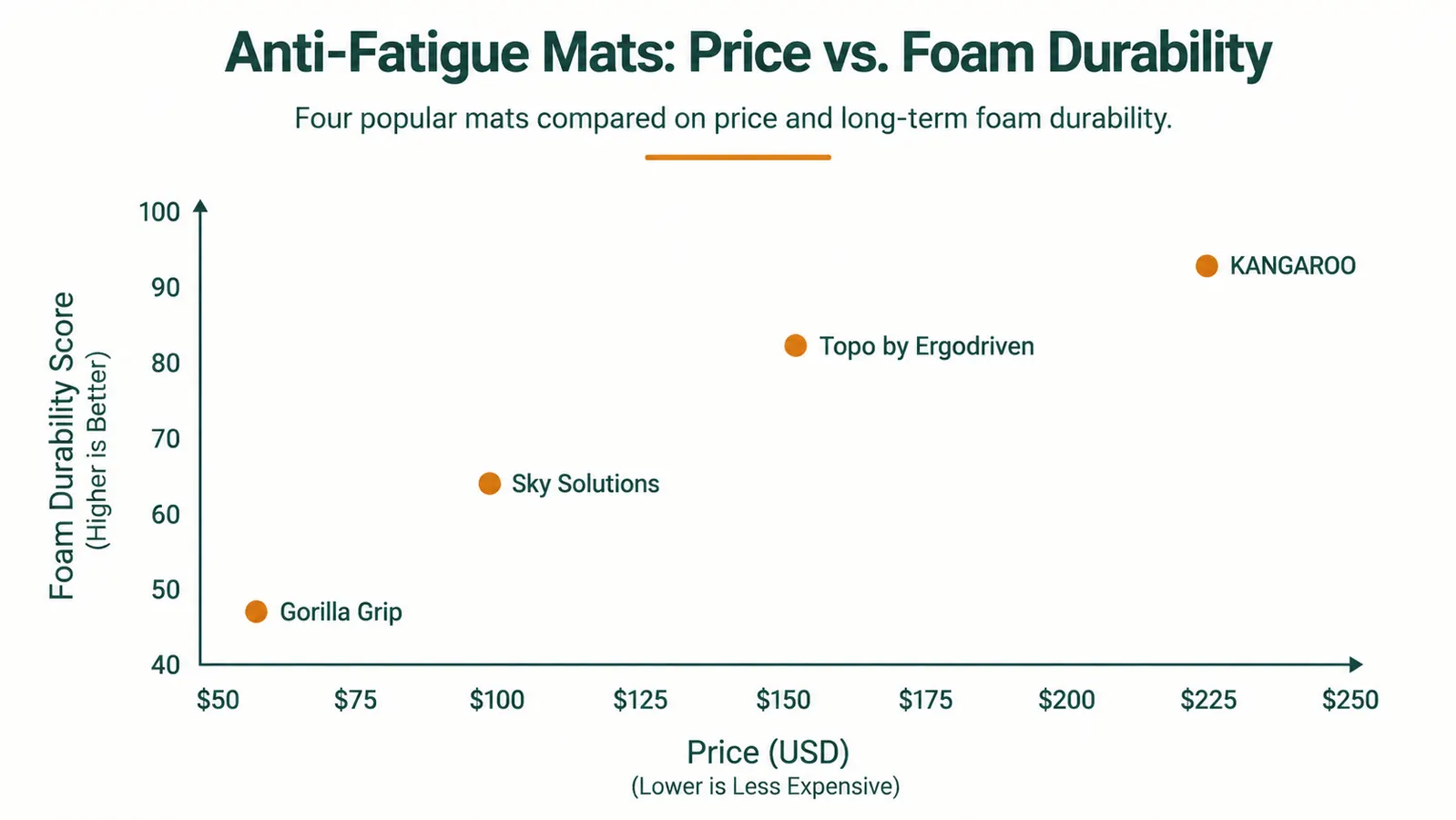
The no-name generic I bought first was a budget mat from a seller with no brand presence. It was 1/2 inch thick and compressed to about 1/4 inch within six weeks. It felt plush on day one and dead within two months. That experience is what most people are trying to avoid, and it is what makes the KANGAROO look good in comparison. Relative to that experience, the KANGAROO holds up well. But that is a low bar.
The Sky Solutions cushion mat, priced in the mid range, has a similar thickness and foam category to the KANGAROO. In side-by-side testing, the Sky Solutions mat felt marginally softer underfoot when new, and the KANGAROO felt slightly firmer. Over time, the softer starting point of the Sky Solutions mat meant it compressed faster. By the three-month mark in the same standing zone, the KANGAROO had held its shape better. If you are choosing between those two, the KANGAROO wins on durability for standing desk use.
The Ergodriven Topo is a completely different product category. It costs four to five times as much and has a terrain design with raised zones and a central dome. The terrain is designed to encourage micro-movements while you stand, shifting your weight from the flat zone to the raised zone to the slope. If you are already an active stander who naturally shifts around, the terrain matters. If you stand in one position and type, which is most people, the terrain advantage shrinks considerably and you are paying for a feature you may not use. The Topo is genuinely better foam and will outlast the KANGAROO. Whether the price gap is justified depends entirely on your standing habits.
The KANGAROO is not the best anti-fatigue mat money can buy. It is the best anti-fatigue mat most remote workers will actually use consistently, because the price does not punish you for trying the habit first.
The Smell Issue: What Nobody Warns You About
Every PVC foam product off-gasses when it ships. The KANGAROO is no different. When you open the box, there is a chemical smell that is noticeable and for some people unpleasant. In a small or poorly ventilated home office, this can be an issue for the first day or two. The smell dissipated in my setup within 48 hours with normal ventilation. In a sealed room with no airflow, I have heard from other home office users who found it lingered longer.
The practical fix: unbox the mat and let it sit in a ventilated space for 24 to 48 hours before you use it in your primary workspace. This applies to any PVC foam mat in this price range, not just the KANGAROO. The product listing mentions nothing about off-gassing. If you are chemically sensitive or work in a small room, plan for two days of airing out before you bring it into your workspace. This is the most common complaint in the one-star and two-star reviews, and it is almost entirely avoidable with that 48-hour window.
The Placement Mistakes Most Buyers Make
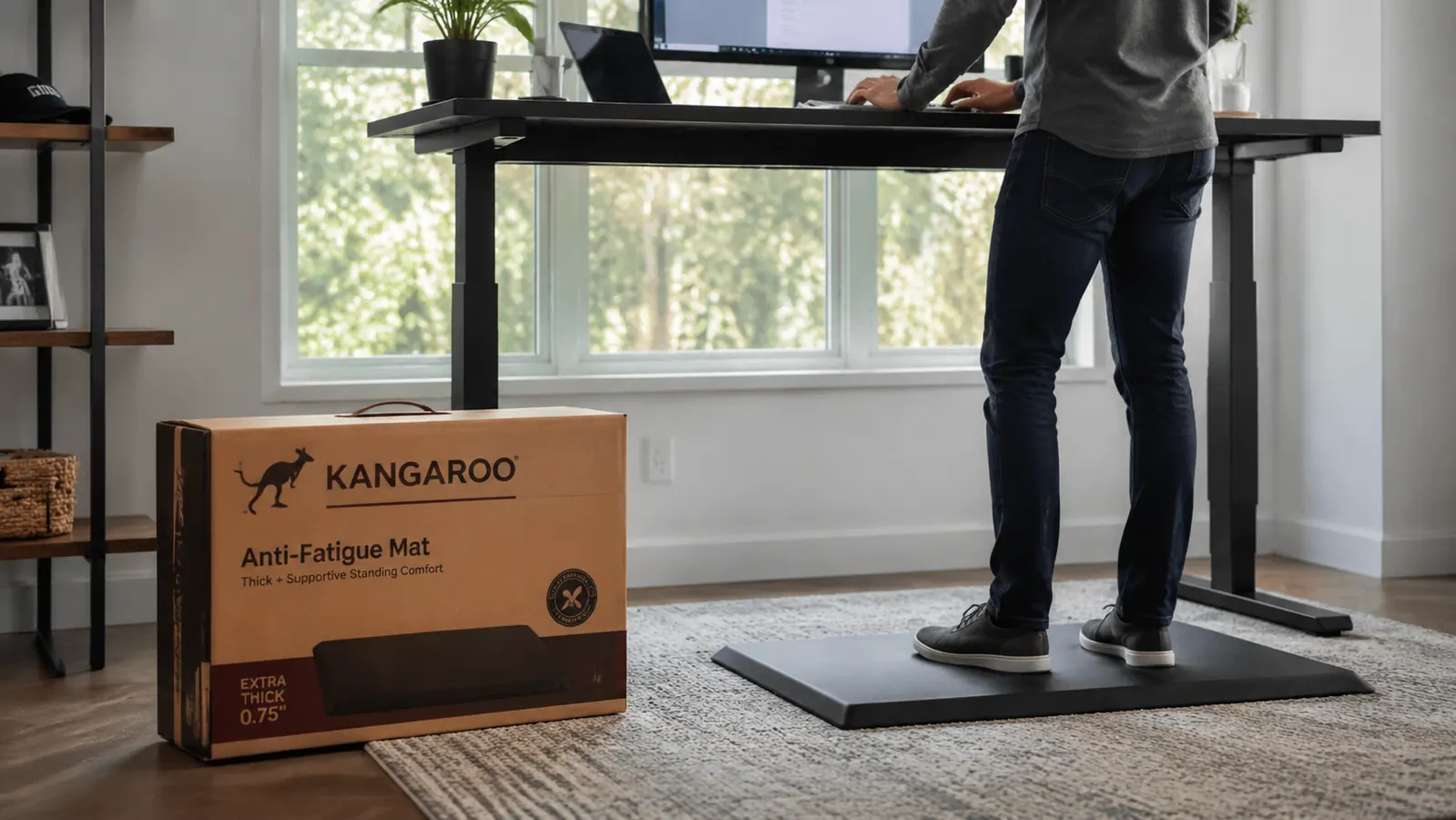
Anti-fatigue mats only work if they are positioned where you actually stand. That sounds obvious, but most people position the mat based on where their desk chair goes, not where they stand when the desk is raised. These are two different positions. When you lower a standing desk converter back to sitting height and push your chair in, the mat ends up under the chair or shoved to one side. When you raise the converter to standing height, you naturally step forward to get close to the keyboard. If the mat is not in that forward position, you step onto it partially or miss it entirely.
The fix is to mark where your feet naturally land when you are standing at typing height, then position the mat around that mark rather than around the desk leg geometry. I put a small piece of tape on the floor the first week to identify my natural standing position before I placed the mat permanently. It sounds fussy but it takes 30 seconds and means the mat is under your feet rather than three inches behind your heels.
The second placement mistake is using the mat on carpet. The KANGAROO is designed for hard floors. On carpet, the textured underside loses its grip advantage, the mat can bunch and shift, and the cushioning benefit is partially negated by the carpet cushion underneath. If your home office is carpeted, you either do not need a mat or you need a mat specifically designed for use on carpet with a non-slip base that grips carpet fibers. The KANGAROO is not that product.
What the Foam Actually Does to Your Joints
The mechanism here is straightforward. When you stand on a hard surface, your joints, feet, ankles, knees, and hips absorb impact and vibration with no buffering. That is not a problem for short periods. For extended standing, the cumulative load adds up. An anti-fatigue mat introduces a compliant layer between your feet and the floor. Your foot sinks slightly into the foam, which shifts the load-bearing from your joints to the foam itself. Your leg muscles also engage more to maintain balance on the slightly unstable surface, which increases blood circulation and reduces the static fatigue that builds up when you stand perfectly rigid on a hard floor.
The KANGAROO's foam is firm enough that this mechanism works properly. A mat that is too soft provides the wrong kind of instability and can actually increase fatigue rather than reduce it. I noticed this with the generic mat I mentioned earlier. By the time it had compressed to 1/4 inch, standing on it felt like standing on a slightly spongy floor, which made my legs work harder rather than less. The KANGAROO's foam stays in the range where the instability is beneficial rather than fatiguing, at least through the first several months of use.
When to Replace It and What the Warning Signs Are
Most mat reviews tell you the mat holds up great and leave it there. The honest answer is that PVC foam mats have a lifespan that depends on how many hours per day you use them, your body weight, and whether you stand in the same spot every time. For average home office use, meaning four to six hours a day at a standing desk, I think the KANGAROO gives you a useful life of 12 to 18 months before the central foam has compressed enough to meaningfully reduce the cushioning benefit.
Here is how to check without guessing: press your palm firmly into the mat in the area where you normally stand, then press your palm into a part of the mat you never use, typically near one edge. If the two areas feel noticeably different in firmness, the foam has compressed in your standing zone. When the difference becomes significant, meaning the standing zone feels close to what the floor feels like underneath, it is time to replace. That test takes ten seconds and gives you a real answer instead of relying on a date on a calendar.
Rotating the mat 180 degrees every three to four months also extends the lifespan. If you always stand toward one end of the mat, flipping it puts fresh foam under your feet and lets the compressed zone recover somewhat. Not every mat shape allows this, but the 20-by-32-inch KANGAROO is square enough that rotation works. I started doing this at month six and it made a meaningful difference in how even the wear felt.
What I Liked
- Firm enough foam that it holds its cushioning through real standing desk use, not just kitchen use
- Beveled edges on all four sides are genuinely gradual, no stubbed toes and no tripping hazard
- Does not shift on hardwood during normal use without any adhesive
- Easy to wipe down with a damp cloth, resists minor spills without staining
- Reasonably priced most days, low-stakes enough to buy before you know whether you will stick with standing
- Available in multiple sizes, including options for wider stances and active movement users
Where It Falls Short
- Off-gasses for 24 to 48 hours on arrival, needs ventilation before use in a small workspace
- Listed as a kitchen mat, not purpose-designed for standing desk hours, and the foam reflects that at the 12 to 18 month mark
- Size looks larger in listing photos than it arrives; 20x32 is genuinely small for people who shift weight actively
- Does not belong on carpet, grip and cushion benefits are both reduced on soft flooring
- No terrain design to encourage micro-movement, fine for still standers, limiting for active ones
The Question Nobody Asks But Should: Is This the Right Price Point to Buy
There is a version of this purchase decision that makes a lot of sense: you are new to standing desks, you are not sure whether you will use the standing mode consistently, and you want to find out without spending serious money on a mat. The KANGAROO is designed for exactly that scenario. You are buying optionality. If you start standing and find out it is not for you, you are out minimal cost. If you start standing and it becomes part of your daily routine, you have a mat that will carry you through the first year and then you can upgrade with full knowledge of what you actually want in a mat.
The version that does not make sense: you are already a committed standing desk user who stands six or more hours a day and you want a mat that will last several years. At that usage level, the KANGAROO will need replacing in 12 to 18 months, possibly less. You are better off buying a higher-density mat from a brand that makes standing desk mats specifically rather than one that primarily makes kitchen mats and benefits from the standing desk adjacent search traffic. The math works out similarly over two or three years and you get a better experience.
Who This Is For
The KANGAROO anti-fatigue mat is the right buy for someone new to standing desks who wants to solve foot fatigue without a big financial commitment. It is also right for anyone on a tight home office budget who needs a mat that is meaningfully better than standing on hardwood and is not willing to spend a premium to find out. If you stand four to six hours a day, have hardwood or tile floors, and primarily stand in one spot rather than moving actively, this mat handles your situation well for at least a year.
Who Should Skip It
Skip the KANGAROO if you stand on carpet, because it is designed for hard floors and the benefits are reduced on soft surfaces. Skip it if you already know you want a terrain-style mat and you are comfortable with the higher price. Skip it if you stand more than six hours a day in the same spot and you want a mat that will last more than 18 months without significant foam compression. And skip it if you work in a small or poorly ventilated room and chemical sensitivity is a concern, because the off-gassing is real and the listing will not warn you about it.
Standing on hardwood all day is the problem. Fixing it affordably is a straightforward call.
The KANGAROO mat is the practical starting point for most home office standing desk setups. It is not a lifetime product, but it does the job it is sold to do for the first year and beyond. Check the current price on Amazon before buying something more expensive just because the listing looks fancier.
Amazon Check Today's Price on Amazon →